


Only Time for One BFCM Test? Choose the Decision, Not the Tactic
Choose one useful BFCM A/B test around your biggest unresolved decision. Check shopper behavior, profit metrics, traffic, and time to act before launch.
Your discount is approved. The emails are being built. Paid traffic is about to ramp up.
Then someone suggests a different offer. Someone else wants a new landing page.
Both might be worth testing. But which answer would actually change your BFCM plan?
ABConvert founder Jeffrey Lin put the starting point plainly in his conversation with Steve Hutt:
"Work backward from the most uncertain part of your BFCM plan and run that exact test."
Jeffrey Lin, eCommerce Fastlane.
Here is a practical worksheet for turning that advice into a useful test. The worksheet is an editorial extension of the conversation, not a transcript or a reported test result.
01Who this is for
This is for Shopify operators deciding where to spend their remaining pre-promotion traffic and attention.
02Write the decision before choosing the change
Testing the landing page names a task. It does not explain what you need to learn.
Try finishing this sentence:
We need to decide whether to ______ before ______.
For example: keep the current promotion or use a smaller discount before the campaign creative is finalized.
Then ask: what would you do differently if either option performed better?
If the answer would not change your plan, that test may not deserve your remaining traffic. If you cannot launch either outcome in time, the learning may be more useful for your next promotion.
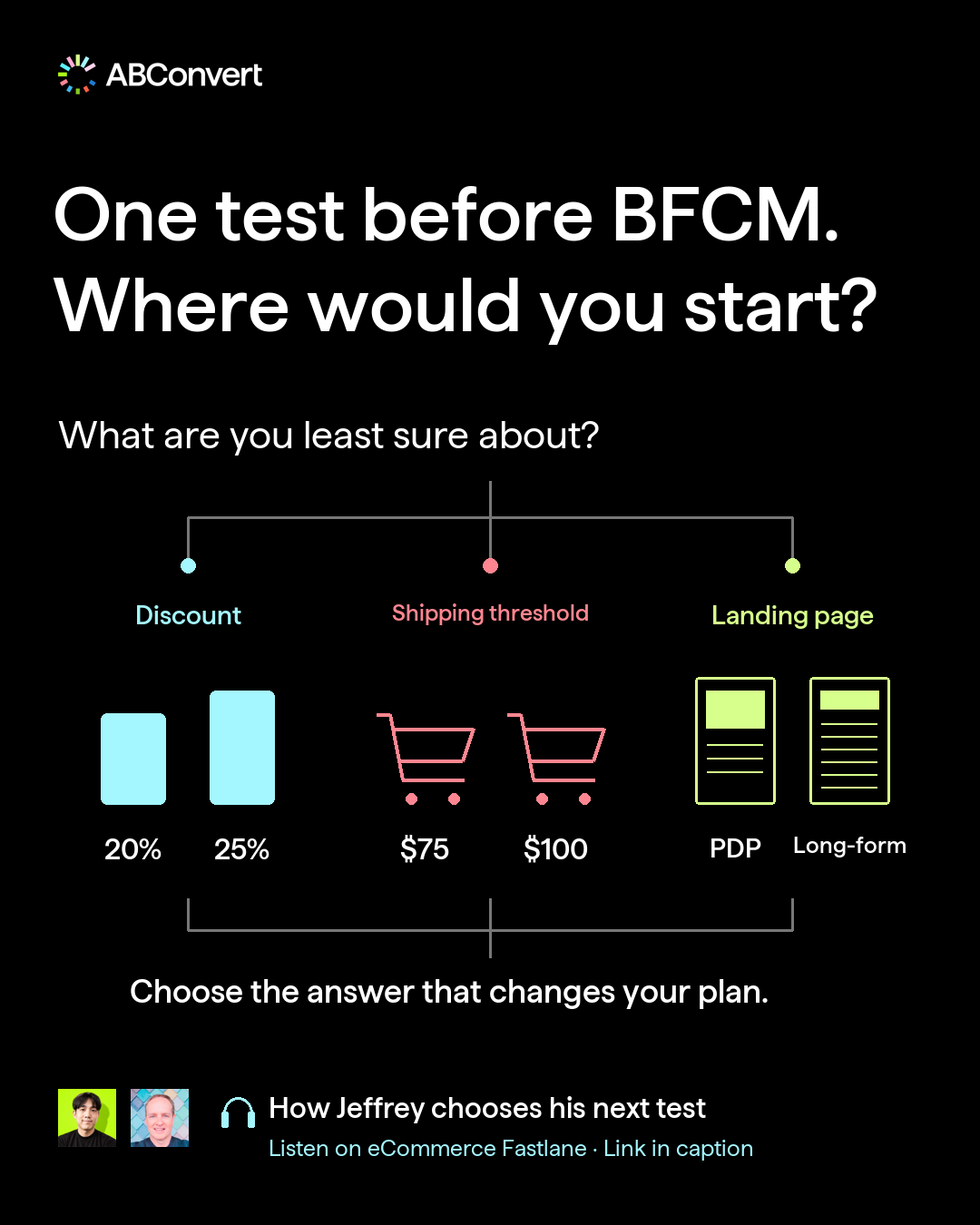
Listen to Jeffrey and Steve's conversation.
03Check what shoppers would actually do differently
Jeffrey's advice on page testing starts with understanding the problem:
"know where the problem is"
Jeffrey Lin, eCommerce Fastlane.
That distinction matters beyond page design. In the conversation, he gives a hypothetical shipping example: a product costs $60, with no cheaper add-ons. Both a $75 and a $100 free-shipping threshold require a shopper to buy two items.
Different thresholds. The same minimum item count.
Before choosing a shipping test, check your common baskets, available add-ons, shipping costs, and whether the offer is explained consistently.
Apply the same discipline to a landing-page test. Is the concern an unclear offer, missing reassurance, or a mismatch between the ad and its destination? Compare similar traffic sources and devices before treating a page-level difference as a design problem. Our landing-page CRO guide explores those purchase questions in more detail.
Write the behavior you expect to change. Then choose a test that can reveal whether it does.
04Define a useful answer before launch
A conversion increase is not a complete decision rule. Neither is a bigger basket.
Before launching, write down:
- Decision: What will we change if the evidence supports it?
- Primary metric: Which number best represents the commercial goal?
- Guardrails: What deterioration would make the result unacceptable?
- Action deadline: When must we decide, leaving time to implement and QA?
For a hypothetical shipping test, contribution margin per visitor could be the primary metric, with conversion and checkout completion as guardrails. Use a consistent cost definition across both sides, including the relevant product, payment, fulfillment, and shipping costs.
If those costs are unavailable, say so. Revenue per visitor can help interpret conversion and order value together, but it cannot establish profitability. The same distinction matters when choosing what to measure in a price test.
Also record who owns the final change. A result nobody can implement before the promotion is a different kind of opportunity.
05Leave room for an inconclusive result
Jeffrey's prioritization advice includes a useful restraint:
"Don't be greedy."
Jeffrey Lin, eCommerce Fastlane.
An action deadline does not guarantee that your test will produce a clear answer by then. Check feasibility before launch, and do not turn an inconclusive result into proof that the options are equivalent.
If the evidence remains unclear, document what you learned and decide whether to retain the current setup or revisit the question later. Do not force a winner because the campaign calendar needs one.
Pre-promotion shoppers may also behave differently from peak-season shoppers. Treat what you learn as evidence with limits, not a guarantee about BFCM.
06Check your plan before committing traffic
- The answer could change a real promotion decision.
- The hypothesis names a shopper behavior, not just a design change.
- Eligible traffic and the remaining window make the test feasible.
- The primary metric, guardrails, and cost definitions are agreed before launch.
- Someone owns setup, interpretation, rollout, and QA.
- An inconclusive result will not be relabeled as a winner.
The goal is not to squeeze in another test. It is to arrive at your promotion with fewer expensive assumptions and a clear reason for the decisions you make.
Choose the next BFCM decision worth testing
Use the playbook's planning and prioritization guidance alongside your own traffic, costs, and promotion schedule.



