


What Leading CRO Agencies Test Before BFCM
Learn what leading CRO agencies test before BFCM and how to prioritize experiments that improve conversion and revenue.
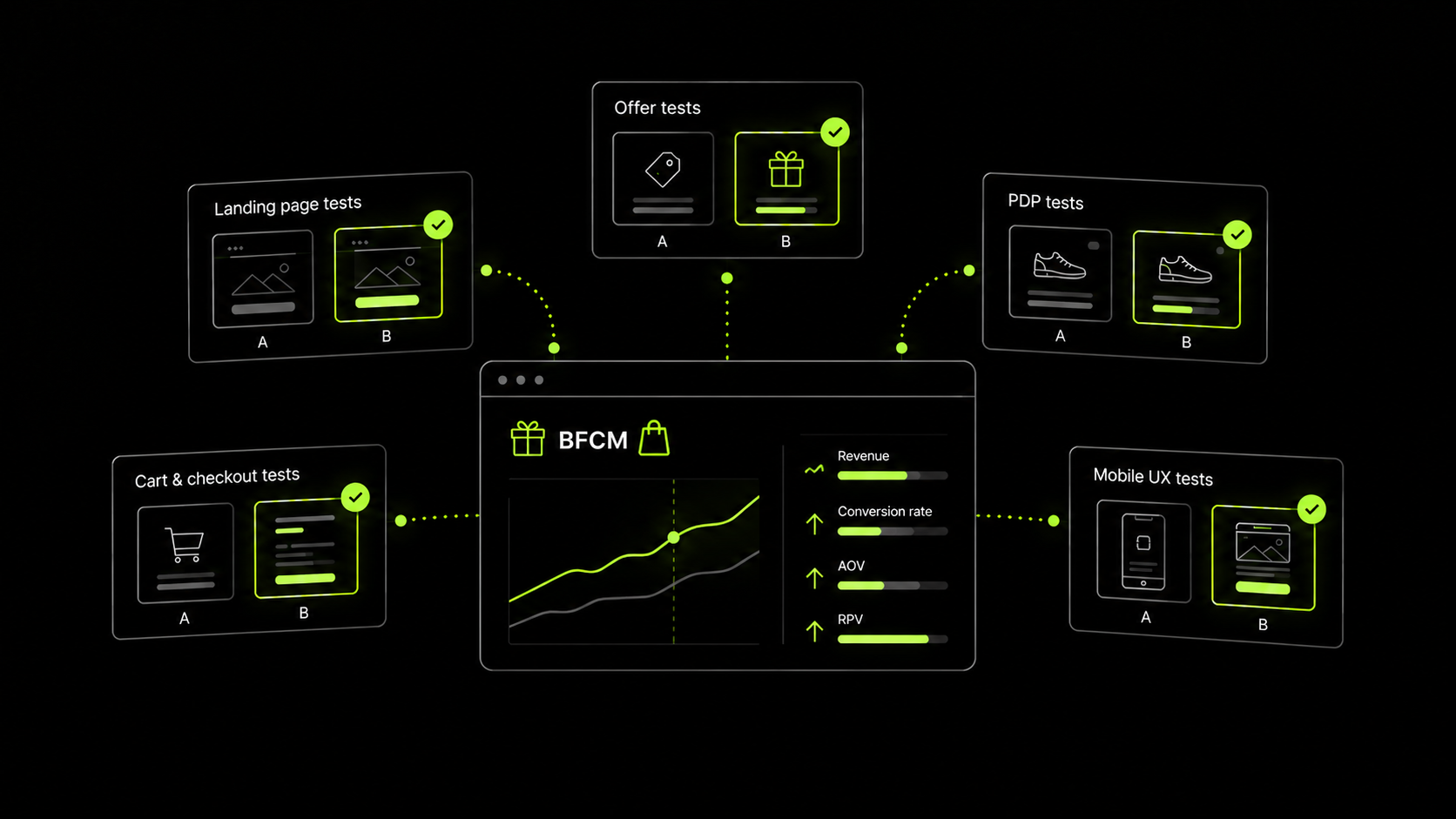
What should you prioritize testing before Black Friday Cyber Monday?
We spoke to Apex, Scaling.co, Shivook, and Prosper Digital about the experiments they run ahead of BFCM. We also looked at ABConvert’s pre-BFCM experiment data to see which areas merchants are testing most.
Here are the experiments to consider as you prepare your store for the sale.
Download our BFCM CRO Playbook
For a more detailed breakdown of how to plan, run, and measure your pre-BFCM experiments.
01Agencies are prioritizing problems, not tactics
Start by identifying where shoppers drop off to decide what to test.
A landing page with low add-to-cart rates needs a different investigation from a checkout where shoppers abandon their orders.
Shivook uses these funnel patterns to guide the diagnosis:
- High landing-page bounce and low add-to-cart rates: Check the first screen, offer clarity, and whether the landing page matches the traffic source.
- Healthy add-to-cart rates but high cart abandonment: Investigate shipping costs, gift offers, and cart messaging.
- Checkout starts increase, but purchases remain flat: Check payment methods, unexpected fees, and missing checkout information.
- Purchases are healthy, but AOV remains flat: Look at pack architecture, bundles, and post-purchase offers.
Segment data by traffic source, device, customer type, and product to narrow down the cause. For example, if mobile shoppers have lower add-to-cart rates than desktop shoppers, investigate the mobile landing page and buy box before changing the experience for everyone.
Once you've identified the problem, decide whether to fix it or test a solution. Broken functionality, tracking errors, and obvious friction should be fixed immediately.
When several plausible solutions could address the same problem, run an experiment to find out which works best.
This keeps the testing roadmap focused on the problems affecting your shoppers’ buying journey.
02Data from pre-BFCM testing in 2025: What merchants tested before BFCM
ABConvert recorded 97 pre-BFCM experiment launches in 2025.
| Test type | Pre-BFCM launches |
|---|---|
| URL redirect | 38.1% |
| Template | 32.9% |
| Theme | 13.4% |
| Shipping | 8.24% |
| Price / Cart transform | 5.15% |
URL Redirect and Template tests made up the bulk of the launches, pointing to a strong focus on landing experiences and page structure. Shipping and pricing tests appeared less frequently in the data.
Note: These figures reflect ABConvert's platform data, not the wider ecommerce industry.
03Test timing depends on the BFCM runway
Work backward from your first major promotional email when planning experiments. Structural changes need more time to implement and validate, while smaller cart and checkout changes can be tested closer to BFCM.
As the deadline approaches, shift from exploring new ideas to implementing proven winners and checking that everything works.
6–8 weeks out: Test structural changes and landing pages
Start with full-page challengers, landing-page tests, and other structural experiments. These changes often require more implementation work and may need additional rounds of testing.
Starting early gives you time to assess results, implement the winner, and QA the experience before traffic peaks.
5–6 weeks out: Test offers and pricing
Test price points, price architecture, and promotional offers. The winning offer may influence your campaign creative, email, and SMS. This is why you need enough time to settle on the approach and implement it before those assets are finalized.
Up to 3 weeks out: Test cart, checkout, and AOV
Move to shorter-cycle experiments involving shipping, cart messaging, checkout, bundles, and other changes intended to improve average order value (AOV).
Prioritize changes you can validate and implement within the remaining time
2 weeks before the first promo email: Freeze major experiments
Stop introducing major changes to the buying path. Implement winning variations, complete QA across devices and key purchase flows, and resolve any issues before the first promotion goes live.
Apex recommends shifting your team's focus as BFCM approaches.
“The closer we get to BFCM, the priority should shift from ‘what could work?’ to ‘what do we already know works?’”
- Apex
04What are CRO agencies testing?
The agencies we spoke to are testing across the BFCM buying journey, from offer construction and landing-page selection to product pages, shipping, and checkout.
Their recommendations point to a common approach: identify where shoppers are getting stuck, and then test the change most likely to address that problem.
The experiments also focus on increasing AOV, improving mobile usability, and refining promotional messaging.
Here’s what agencies are testing in each area, along with results that show how specific changes can affect performance.
CRO experts are prioritizing the offer before peak
Apex, Scaling.co, and Shivook prioritize offer testing ahead of BFCM. Apex estimates that 30–40% of its BFCM testing focuses on offer construction, while Scaling.co allocates roughly 25% of its active pre-BFCM queue to offer and price testing.
These tests cover tiered discounts, spend thresholds, free gifts, bundles, and buy-more-save-more offers. Agencies also examine price architecture and how the offer is presented to shoppers.
Each test should answer a specific commercial question:
- Does a tiered discount increase basket size enough to justify the additional discount?
- Does a gift or spend threshold encourage shoppers to reach a higher order value?
- Does a bundle make a larger purchase more appealing?
Test one variable at a time where possible, so you can identify what drives the result. Once you have the winning offer, use the same structure and messaging across the landing page, ad creative, email, and SMS so shoppers see a consistent promotion throughout the buying journey.
Landing pages are one of the highest-leverage tests
Ahead of BFCM, agencies recommend testing dedicated campaign landing pages, offer pages against product detail pages (PDPs), pre-sell pages, and the path that paid traffic takes to reach the offer.
Ad-to-page message match is critical. The landing page needs to match the promotion and promise that brought shoppers there.
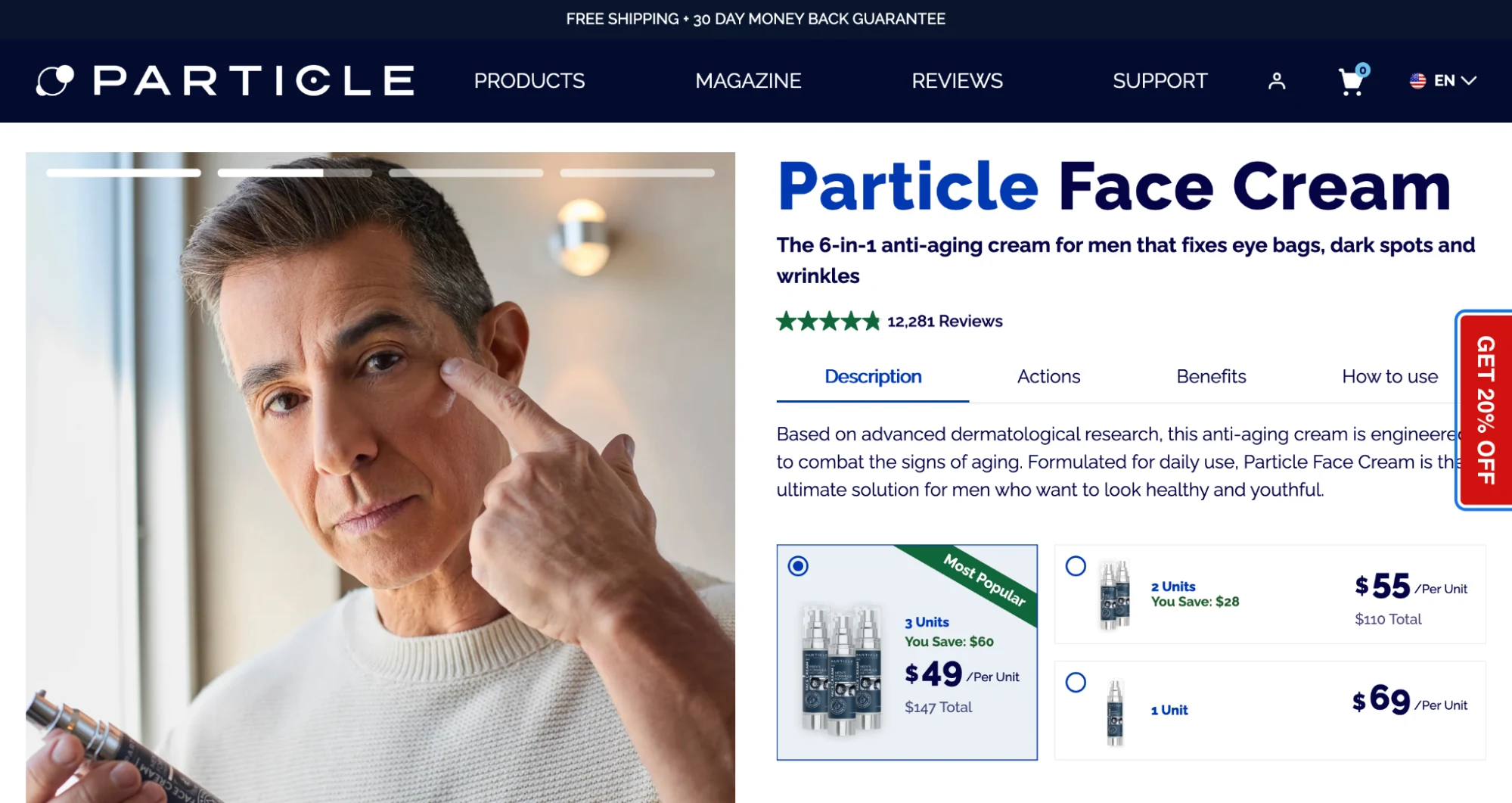
For Particle for Men, Shivook tested a purpose-built offer page against the brand’s existing PDP. The offer page generated 21.4% higher revenue per visitor (RPV), with 99.5% confidence across 12,893 visitors.
Shivook also found that changing the type of page that shoppers land on delivered a 32.5% median RPV lift, compared to 19.5% when rebuilding the same page type.
Test the destination before assuming the page itself needs a redesign. If paid traffic lands on an experience that doesn’t match the ad or the shopper’s intent, changing headlines or buttons may not address the underlying problem.
PDPs and buy boxes still get attention
Once shoppers reach the product detail page, focus on information and controls that help them make a purchase decision:
- Offer clarity
- Benefit bullets
- Pack and bundle options
- Add-to-cart control
- Placement of reviews, guarantees, and shipping information.
Scaling.co ran a PDP test, moving the benefit bullets from below the fold to a more visible position. Across approximately 21,300 visitors, the change increased conversion rate (CVR) by 55% and revenue per visitor (RPV) by 45%.
Other tests you can run include:
- Simplifying the buy box
- Making higher-value packs easier to select
- Adding a sticky add-to-cart button
- Placing savings or shipping details closer to the purchase decision.
Cart, checkout, and shipping are key testing areas
If cart abandonment is high, investigate the friction before changing other parts of the journey. Shipping costs, delivery expectations, promo fields, and other unnecessary cart elements can all affect the path to checkout.
Common tests include:
- Reducing cart clutter
- Changing how shipping methods are presented
- Testing free-shipping thresholds
- Clarifying delivery expectations
Segment abandonment by device, cart value, customer type, and product category. This can help you identify whether a shipping threshold affects larger orders or whether checkout friction is concentrated among mobile shoppers.
How shipping options are presented can affect conversions too. Scaling.co tested renaming a shipping method to “Priority Care Shipping.” The change increased checkout conversion by 11.5% and RPV by 63%.
Keep shipping experiments separate from discount tests. Changing both at once makes it harder to attribute the result and understand the effect on your margins.
With BFCM approaching, prioritize cart and checkout tests that address known friction and can be validated before the sale. Structural page experiments generally need more lead time for implementation and testing.
Agencies are testing ways to increase AOV
BFCM testing isn’t just focused on conversions. Agencies are also testing ways to increase each purchase's value through cross-sells, cart upsells, gift add-ons, bundle builders, and post-purchase offers.
According to Scaling.co, post-purchase is an undertested area. These offers give brands another opportunity to generate revenue from customers who have already purchased, using traffic they have already paid to acquire.
Test where an offer appears, which products it features, and how it fits the original purchase. For example, a relevant add-on or bundle can encourage shoppers to spend more, while a post-purchase offer can introduce another product after checkout.
Measure the effect on AOV and revenue alongside any impact on conversion. A higher-value order isn't automatically a better result if the change influences more shoppers to abandon their purchase.
Mobile usability and merchandising are part of the testing mix
Mobile deserves particular attention ahead of BFCM. Apex estimates that 70–80% of ecommerce traffic comes from mobile devices.
“I would expect roughly 70-80% of experiments to be explicitly mobile-focused, although most BFCM tests should be evaluated on mobile because it typically represents the majority of traffic. Also, some clients just want to focus 95% on mobile, depending on the traffic.”
- Apex
Start by checking whether mobile shoppers can understand the offer and act on it without unnecessary scrolling or distractions. Test how the offer appears on the first screen, how easily shoppers can use the buy box and add-to-cart controls, and whether shipping and delivery details are visible before checkout.
Check whether cart clutter and navigation make it harder for shoppers to find products or complete an order.
Merchandising and promotional messaging are crucial, too. Test collection layouts, product placement, promotional messaging, and how offers appear when you have evidence that shoppers are struggling to find the right product or understand the promotion.
Prosper Digital emphasizes solving customer problems rather than adding urgency for its own sake:
“Tests that solve your customer’s problems, reduce friction, or make decisions easier are much more effective than countdown timers and ‘6 others have this in their cart’ flags.”
- Prosper Digital
Use funnel data to choose which mobile, merchandising, or messaging changes to test. Urgency cues can be worth testing when they address a specific customer concern. Measure their effect rather than assuming they will improve conversion.
05Prepare your store for BFCM
Leading CRO agencies use the weeks before BFCM to identify what limits performance, test potential improvements, and roll out proven winners before peak traffic arrives.
Start with the areas most likely to affect revenue: your landing-page experience, offer structure, and buying journey. Give tests involving discounts, spend thresholds, bundles, and free gifts enough time to validate their impact on revenue and margin before finalizing your promotion.
ABConvert helps ecommerce teams run A/B tests across their storefront and validate changes before rolling them out.
Download our BFCM CRO Playbook
To plan your testing calendar, prioritize experiments, and prepare your store for peak season.
Want to see how ABConvert can help you run and manage experiments ahead of BFCM?
Start with a 14-day free trial of ABConvert



