

BFCM Experiment Rolodex
Explore proven BFCM CRO experiments for landing pages, offers, pricing, shipping, proof, and checkout, with real test examples and decision rules.
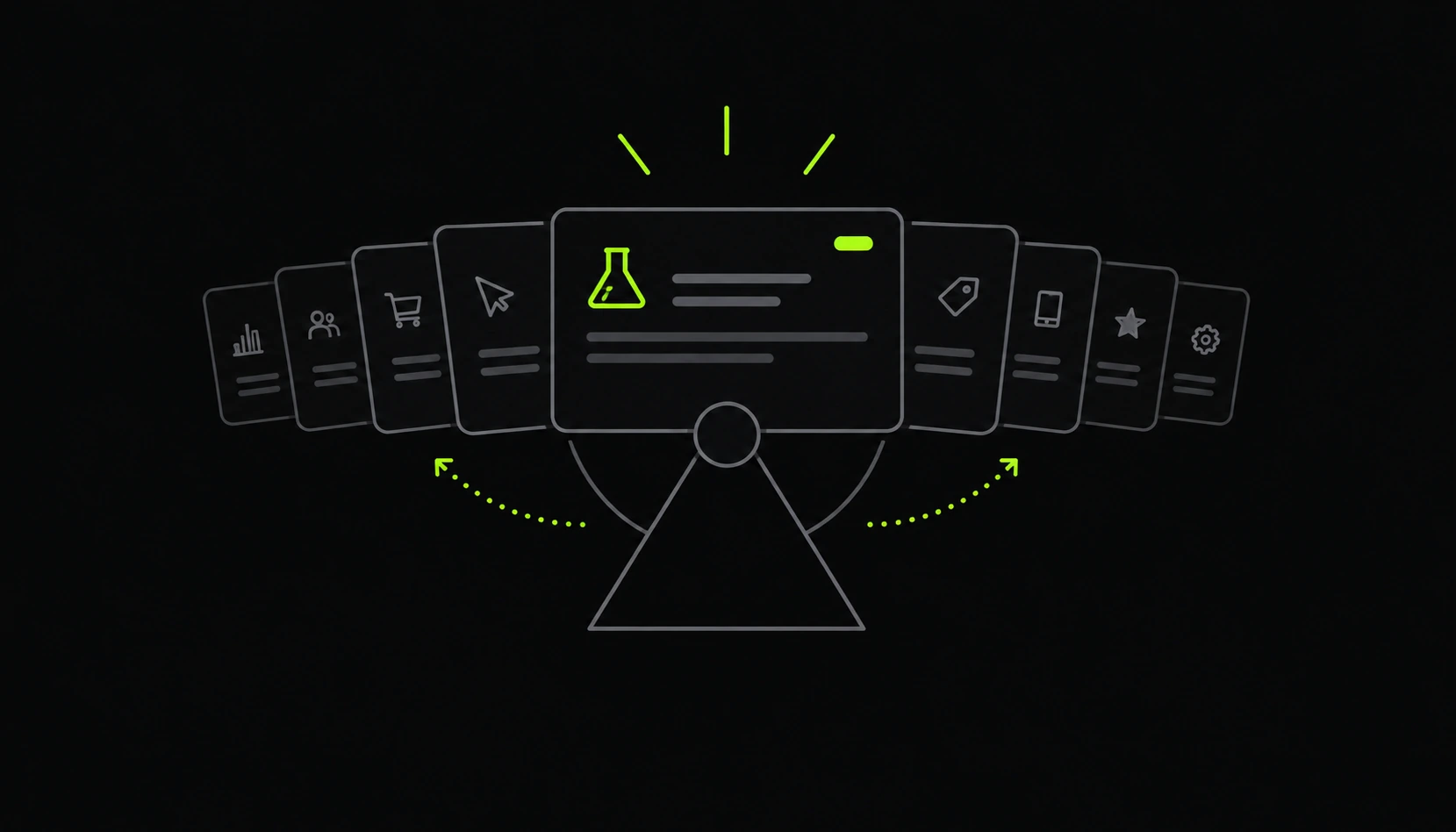
This rolodex makes it easier to find tests worth running, drawing on experiments and insights from ABConvert, Apex, Scaling.co, Shivook, and Prosper Digital. Each recommendation covers what to test, why it matters, how to structure the experiment, and what to measure.
01Offer architecture and discount strategy
1. Product-level price testing
Question: Should different products have different pricing strategies instead of one blanket sitewide discount?
Ideal if: Your products have enough volume per SKU to reach significance, especially if a flagship product or small group of SKUs drives most of your revenue.
Hypothesis: Different products may have different optimal price points, making product-level pricing a useful alternative to a blanket discount.
How to:
- Test different price variations at the product level against the control.
- Keep traffic source, shipping, and other sitewide promotions consistent.
- Start early enough to learn and implement the result before BFCM.
Timing/runway: Start in late August up until late October. This is a structural offer decision that needs to be resolved before you build your BFCM creative, email, and SMS around it.
Metrics to measure:
- Primary: Contribution margin per visitor
- Secondary: RPV, AOV, and units per order
Decision rule: Evaluate the price strategy on contribution per visitor, not CVR alone. If test-attributed revenue is unavailable, don't use merchant-level sales growth as proof of the test's impact.
Source: ABConvert
2. Sequencing price and shipping tests
Question: When both the discount and free-shipping threshold need to change, which should you test first?
Ideal if: You're changing both a discount and a free-shipping threshold heading into BFCM.
Hypothesis: Testing each lever separately makes it easier to isolate its impact. Changing both at once makes the results harder to interpret and can create unnecessary margin pressure.
How to:
- Lock the shipping threshold and test the discount (e.g., 20% → 25%).
- Once you've selected the discount, hold it constant and test the free-shipping threshold.
- Don't change both levers in the same variant.
Timing/runway: Launch the offer test in early to mid-October, and test shipping with enough time to implement the winner. Freeze both two weeks before BFCM.
Metrics to measure:
- Primary: Contribution margin per visitor
- Secondary: RPV, AOV, shipping cost per order
Decision rule: Only ship the result when you can attribute the impact to the variable being tested.
Source: ABConvert; Apex
3. Free-shipping threshold change
Question: Does lowering the free-shipping threshold and increasing conversion actually improve the economics?
Ideal if: Shipping subsidy is a meaningful part of your order cost, especially if you have lower AOV or tighter margins.
Hypothesis: A lower threshold may increase CVR while reducing AOV and increasing shipping costs, so the overall commercial result can still be negative.
How to:
- Test a threshold change, such as $75 to $50, and measure the full economic impact rather than CVR alone.
- Measure the effect on conversion, order value, shipping cost, and contribution.
- Segment by cart value, device, and new vs. returning visitors where useful.
Timing/runway: Launch in October once the discount test is settled. Leave roughly three weeks before sending the first promotion and freeze the results two weeks out.
Metrics to measure:
- Primary: Contribution margin per visitor
- Secondary: CVR, AOV, RPV, shipping cost per order, units per order, and refund/cancellation rate.
Decision rule: Decide based on contribution per visitor, not CVR. In a test run by Apex, CVR increased by 12% and RPV by 3% while reducing contribution margin per visitor by 4%.
Source: Apex
4. Multi-pack default vs. single default on the PDP
Question: Does making a multi-pack the default selection lift AOV and RPV?
Ideal if: You sell discounted multi-packs, but most customers still buy single units.
Hypothesis: Making the multi-pack easier to select could capture multi-unit demand and increase order value.
How to:
- Make the multi-pack the default option and test it against the current single-default PDP.
- Keep traffic and pricing consistent between variants.
- Make sure the intended pack pricing is applied correctly through cart and checkout.
Timing/runway: Launch early enough to have the result settled by mid-October, with the final test frozen two weeks before BFCM.
Metrics to measure:
- Primary: AOV and RPV
- Secondary: Units per order and percentage of multi-unit orders
Decision rule: Evaluate the winner on RPV and AOV, with particular attention to whether the multi-pack default increases order value without adding friction.
Source:Scaling.co
5. Offer construction
Question: Which BFCM offer structure drives higher conversions without giving away unnecessary margin?
Ideal if: You're still deciding between offer structures such as tiered discounts, spend thresholds, free gifts, bundles, or buy-more-save-more.
Hypothesis: The structure of the offer can have a larger impact than simply increasing the discount depth.
How to:
- Choose one offer mechanic to test against the current offer.
- Keep other commercial variables consistent so you can isolate the effect of the offer structure.
- Evaluate the result on both conversion and economics.
Timing/runway: Test from September through early October. Major offer changes should be decided before creative, email, and SMS production.
Metrics to measure:
- Primary: Contribution per visitor
- Secondary: RPV, CVR, AOV
Decision rule: Evaluate the offer on its commercial impact rather than CVR alone.
Source: Apex
02Landing-page destination and page type
6. New page type vs. rebuilt same page type
Question: Does changing the page type outperform rebuilding the page you're already using?
Ideal if: Your paid traffic lands on a homepage, collection page, or generic PDP that wasn't built specifically for that traffic.
Hypothesis: A page built around the traffic's intent can outperform a better version of the existing page type.
How to:
- Send the paid traffic segment to a purpose-built offer page or other page type suited to the traffic, and test it against the existing experience.
- Keep the offer and price the same on both sides.
- Keep traffic source, shipping, and measurement consistent.
Timing/runway: Start in late August through September. Give structural page tests enough runway to reach a result and implement the winner before the first promo send. Freeze two weeks before BFCM.
Metrics to measure:
- Primary: RPV
- Secondary: CVR, AOV
Decision rule: Use the pre-defined RPV and statistical criteria for the test. For context, Shivook uses a 10% RPV lift as its win threshold for its full-page challenger library.
Source: Shivook
7. Send warm listicle traffic to offer page vs PDP
Question: Should traffic that just read a long-form listicle land on the standard PDP or on a page that continues the argument?
Ideal if: You send listicle or other warmed-up traffic straight to a standard PDP.
Hypothesis: A visitor coming from a listicle is already partway through a specific buying journey. A purpose-built offer page can continue that journey instead of making them start over on a standard PDP.
How to:
- Keep the listicle, traffic source, offer, and price the same.
- Split traffic at the CTA between the existing PDP and a purpose-built offer page.
- Keep the test focused on the destination page.
Timing/runway: Launch by the end of September to leave enough time for a clean read and implementation. Freeze the buying path roughly 2 weeks before BFCM.
Metrics to measure:
- Primary: RPV
- Secondary: CVR, downstream cart and checkout performance
Decision rule: Use the pre-defined RPV and statistical criteria for the test.
Source: Shivook
8. Send cold Meta traffic to home page vs. pre-sell
Question: Where should cold paid-social traffic land when the product needs more context before the purchase decision?
Ideal if: You run cold Meta traffic, particularly for products where shoppers need more explanation before they're ready to buy.
Hypothesis: Cold social traffic may need more context before seeing an offer. A pre-sell page can build that context before sending shoppers to the offer page.
How to:
- Split Meta traffic between the existing home page and the pre-sell → offer page path.
- Use a listicle as the pre-sell, with CTAs leading to an offer page for the same product.
- Keep the offer page deliberately simple so the test isolates the impact of the path rather than page design.
Timing/runway: Start in late August or September. Allow enough time to reach a result and implement the winner before BFCM. Freeze two weeks before peak.
Metrics to measure:
- Primary: RPV
- Secondary: CVR
Decision rule: Evaluate the path on RPV and statistical significance rather than landing-page CVR alone.
Source: Shivook
9. PDP vs. sales/listicle landing
Question: For campaign traffic, does a PDP or sales/listicle landing page perform better?
Ideal if: You send campaign traffic to a single destination and want to test whether a different landing experience performs better.
Hypothesis: Where campaign traffic lands can have a meaningful impact on performance, making the destination page a CRO lever worth testing.
How to:
- Send the same campaign traffic and offer to the existing PDP and a sales/listicle landing page.
- Keep the offer and price consistent between variants.
- Use a redirect when the alternative page or path can't be cleanly tested on the same URL.
- Keep the test focused on the landing experience rather than introducing unrelated changes.
Timing/runway: Launch in September, before creative and message-match work is finalized. The last launch should be ~6 weeks before the first promo send. Freeze major changes two weeks before BFCM.
Metrics to measure:
- Primary: RPV
- Secondary: CVR, and downstream cart and checkout performance
Decision rule: Evaluate the route on revenue through purchase, not landing-page CVR alone. A change that adds or removes steps in the buying path can have a very different impact further down the funnel.
Source: ABConvert; Scaling.co
10. Stripped landing page vs. native navigation
Question: Does removing the header and footer improve landing-page performance, or does keeping the site's native navigation work better?
Ideal if: You use dedicated paid landing pages with the header and footer removed.
Hypothesis: Removing navigation and trust cues doesn't always help. Keeping the native header and footer may give shoppers more context and confidence to continue toward purchase.
How to:
- Test the stripped landing page against the same page with the native header and footer restored.
- Keep the offer, traffic, and rest of the page consistent.
- Measure the impact through the buying journey, not just the landing page.
Timing/runway: Launch during the September structural testing window. Last launch ~6 weeks before the first promo send and freeze major changes two weeks before BFCM.
Metrics to measure:
- Primary: RPV
- Secondary: ATC
Decision rule: Ship the winner if the RPV improvement meets your pre-defined statistical criteria.
Source: Scaling.co
11. Advertorial/pre-sell vs. PDP
Question: Does an advertorial or pre-sell page outperform the PDP for high-bounce cold traffic?
Ideal if: Your cold paid traffic has high bounce and low scroll, particularly when it lands on a generic page that wasn't built for that traffic.
Hypothesis: Cold social traffic may need an editorial pre-sell before it reaches the offer.
How to:
- Route the cold traffic segment to an advertorial/pre-sell page against the existing PDP.
- Keep the traffic source, offer, price, shipping, and measurement consistent across variants.
- Shivook's Uresta test returned a 70% increase in RPV for the advertorial vs. PDP.
Timing/runway: Launch late August to September. Freeze the buying path roughly 2 weeks before the first promo send.
Metrics to measure:
- Primary: RPV
- Secondary: CVR, add-to-cart rate
Decision rule: Use the pre-defined RPV and statistical criteria for the test. For context, Shivook used a 10% RPV lift as its win threshold for its full-page challenger library.
Source: Shivook
12. Low-traffic brands: Single big-swing challenger
Question: With limited volume, what one test should you run in the pre-BFCM window?
Ideal if: A single SKU on a single traffic source cannot reach significance within roughly 14 days.
Hypothesis: At lower traffic volumes, small element tests can spend the entire pre-BFCM window trying to detect an effect that's too small to reliably measure. A larger page or path change gives the test a better chance of producing a useful result.
How to:
- Test the biggest swing you're willing to build.
- Concentrate traffic on one hero page and one source rather than splitting it across multiple concurrent challengers.
- Use RPV as the primary metric because it captures both conversion and AOV.
Timing/runway: Launch late August to September. Start early enough to allow the full test to resolve before the buying-path freeze, roughly 2 weeks before the first promo email.
Metrics to measure:
- Primary: RPV
- Secondary: CVR, AOV
Decision rule: Use the pre-defined RPV and statistical criteria for the test. For context, Shivook uses a 10% RPV lift as its win threshold for its full-page challenger library.
Source: Shivook
03Proof hierarchy and placement
13. Proof placement by surface
Question: Does adding trust/proof to a page help, and does it help on this touchpoint?
Ideal if: Your proof is generic, in the wrong place, or competing with the decision the shopper is making right now.
Hypothesis: Proof should help when it answers a question the shopper is actively trying to resolve, but adding more proof to an already-clear offer can create friction.
How to:
- Test proof placement on the surface where the decision is being made.
- Use real proof and live on-site numbers rather than introducing unsupported claims.
- Compare relevant proof against the current experience rather than assuming more proof will improve performance.
Timing/runway: Launch between late September and mid-October. Freeze the buying path roughly 2 weeks before the first promo email.
Metrics to measure:
- Primary: RPV
- Secondary: Surface-specific completion rate or conversion rate
Decision rule: Prioritize proof when it removes confusion around the decision the shopper is making on that surface. Don't ship a proof change simply because it adds more trust signals.
Source: Scaling.co
14. PDP benefit bullets below the fold
Question: Does clearer benefit information on the PDP move revenue?
Ideal if: Your ad makes a promise the PDP doesn't restate, particularly for higher-consideration or high-AOV products.
Hypothesis: Making the product's key benefits clearer can improve conversion and revenue when shoppers need more information before purchasing.
How to:
- Add benefit bullets below the fold that reinforce the key product benefits.
- Test against the existing PDP without changing unrelated elements.
- Scaling.co's high-AOV radio brand saw +55% CVR and +45% RPV across ~21,300 visitors, with both results statistically significant.
Timing/runway: Launch between late August and September so structural PDP work is locked by mid-October. Last launch should be ~5–6 weeks before the first promo send and frozen 2 weeks out.
Metrics to measure:
- Primary: RPV
- Secondary: CVR
Decision rule: Evaluate the change in RPV first, with CVR as a diagnostic. A CVR lift without a corresponding RPV improvement should not be treated as an RPV win.
Source:Scaling.co
04Cart, checkout, and shipping
15. Shipping-method framing
Question: Does changing how shipping options are presented improve checkout conversion and revenue?
Ideal if: Shoppers reach checkout but may be hesitating over shipping options, delivery expectations, or how those options are framed.
Hypothesis: Clearer shipping-method framing can reduce friction at checkout and improve completed purchases.
How to:
- Test the naming or framing of shipping options against the current presentation.
- Keep the underlying shipping economics unchanged.
- Measure the effect through completed checkout rather than the shipping-selection step alone.
- In a test run by Scaling.co, reframing shipping options increased checkout conversion by 11.5% and RPV by 63%, showing that clearer shipping communication can affect both conversion and revenue.
Timing/runway:Test in late October and resolve before the buying-path freeze ~2 weeks before BFCM.
Metrics to measure:
- Primary: RPV
- Secondary: Checkout conversion rate
Decision rule: Evaluate the change in revenue through checkout, not interaction with the shipping option alone.
Source: Scaling.co
16. Cart path and cross-sell
Question: Does simplifying the cart improve the buying journey, or does removing cross-sell opportunity reduce revenue?
Ideal if: Your cart contains cross-sells, recommendations, or other elements that may compete with the path to checkout.
Hypothesis: Removing cart friction can improve conversion, but removing revenue-generating cross-sells can reduce RPV even when CVR increases.
How to:
- Test the simplified cart against the current cart.
- Keep the underlying offer and traffic consistent.
- Measure both conversion and revenue through purchase.
Timing/runway: Run in late October, after structural and offer tests. Resolve before the buying path freezes ~2 weeks before BFCM
Metrics to measure:
- Primary: RPV
- Secondary: CVR, AOV
Decision rule: Evaluate the cart on RPV, not CVR alone. A conversion lift is not enough if removing the cross-sell reduces revenue per visitor.
Source: Scaling.co
17. Checkout proof placement
Question: Does adding relevant proof to the checkout experience help shoppers complete the purchase?
Ideal if: Shoppers reach checkout but still need reassurance before completing the order.
Hypothesis: Proof placed alongside the final purchase decision can reduce uncertainty without interrupting the checkout flow.
How to:
- Test relevant proof in the order summary against the current checkout.
- Use real reviews or customer information.
- Keep the checkout flow otherwise unchanged.
- Scaling.co's order-summary proof test increased checkout completion by 9.4% across ~4,200 sessions.
Timing/runway: Run in late October, after structural and offer tests. Resolve before the buying path freezes ~2 weeks before BFCM.
Metrics to measure:
- Primary: RPV
- Secondary: Checkout completion rate
Decision rule: Evaluate the treatment on completed purchases, not engagement with the proof itself.
Source: Scaling.co
05Mobile and merchandising
18. Sticky mobile add-to-cart
Question: Does a sticky add-to-cart and a compressed mobile buy box improve conversion on mobile?
Ideal if: Most of your traffic is through mobile and shoppers have to scroll before they can act on the offer.
Hypothesis: On mobile, reducing the distance between the offer and the purchase action can make the buying decision easier and improve conversion.
How to:
- Add a sticky add-to-cart button against the current mobile buy box.
- Bring the offer and price into the first screen and reduce unnecessary content above the CTA.
- Design and QA at ~390px, and then verify the experience on desktop.
- Report results by device, but don't treat device-level results as independently powered segments unless the test was designed that way.
- Evaluate mobile and desktop separately: a change that improves ATF education on desktop can push the CTA below the fold on mobile.
Timing/runway: Launch between late-August and September so the change can be tested and locked by mid-October.
Metrics to measure:
- Primary: RPV
- Secondary: CVR
Decision rule: Evaluate the winner on RPV using your pre-defined statistical criteria.
Source: Apex; Scaling.co; Shivook; Prosper Digital
19. Mobile page decluttering
Question: Is the mobile page converting poorly because it's missing something, or because it's overloaded?
Ideal if: Your mobile page is crowded with shipping, BNPL, reviews, returns, and urgency messages competing for attention.
Hypothesis: Removing competing elements can reduce cognitive load and make the purchase decision easier, rather than adding another conversion nudge.
How to:
- Remove competing elements rather than adding new ones.
- Collapse or simplify promo fields and duplicate shipping or gift messaging.
- Keep the offer and the information needed to make the purchase decision clear.
- Test the decluttered version against the current experience.
- In a test run by Scaling.co, a free-shipping quiz pop-up reduced conversion rate by 8.2% across 10,675 visitors, showing how an added conversion element can hurt performance when it creates friction.
Timing/runway: Launch late September to mid-October. Focus on changes that can be implemented and reversed quickly. Last launch should be ~3 weeks before the first promo send. Freeze the buying path roughly 2 weeks before the first promo email.
Metrics to measure:
- Primary: RPV
- Secondary: CVR
Decision rule: Evaluate the winner on RPV using your pre-defined statistical criteria. A decluttered page should still preserve the information needed to answer the shopper's immediate question.
Source: Prosper Digital; Scaling.co
20. Product vs. lifestyle image tile
Question: Does a product-first or lifestyle-first image help shoppers evaluate products faster on collection pages?
Ideal if: Your lifestyle imagery makes product details such as silhouette, pattern, or fit harder to evaluate.
Hypothesis: A product-first image may make key product details easier to evaluate and improve collection-page conversion.
How to:
- Swap the default collection-tile image from lifestyle to ghost/product.
- Keep the rest of the collection experience unchanged.
- In a test run by Prosper Digital, a women's swimwear brand saw an 8% increase in CVR at 99% significance across 130K weekly sessions. The lift varied by device: 7.3% on mobile and 10.9% on desktop.
Timing/runway: Launch well before peak. Prosper Digital implemented the winner four months out. Last launch should be 6–8 weeks before the first promo send. Freeze the buying path roughly 2 weeks before the first promo email.
Metrics to measure:
- Primary: CVR
- Secondary: CVR by device
Decision rule: Evaluate the winner on CVR using your pre-defined statistical criteria, and then use the device split to inform future collection-page design.
Source: Prosper Digital
21. Collection merchandising
Question: Does changing what shoppers see first on collection pages improve conversion?
Ideal if: Your collection pages send paid traffic into a generic product grid without clearly surfacing the BFCM offer, best sellers, bundles, or giftable products.
Hypothesis: Merchandising the collection around the products and offers most relevant to BFCM intent can make product discovery easier and improve conversion.
How to:
- Test the placement or prominence of sale products, best sellers, bundles, or giftable products.
- Keep the underlying products and offer consistent.
- Focus the test on what shoppers see and how they navigate the collection.
Timing/runway: Launch for September through mid-October for structural merchandising changes. Closer to BFCM, focus on lower-risk merchandising updates.
Metrics to measure:
- Primary: RPV
- Secondary: CVR, product click-through rate
Decision rule: Evaluate the merchandising change on revenue through purchase rather than collection-page engagement alone.
Source: Apex
06Cart and post-purchase AOV
22. Post-purchase / cart upsells
Question: How much incremental AOV can properly configured upsells and add-on offers generate?
Ideal if: You have room to add or improve upsells, add-ons, or package protection without disrupting the core buying path.
Hypothesis: Well-configured upsells and add-on offers can increase AOV from traffic you've already paid to acquire.
How to:
- Test the upsell or add-on offer against a holdout where it is switched off.
- Keep traffic and the underlying offer consistent between variants.
- Test one mechanic at a time so you can isolate its impact.
- Scaling.co's deployments of pre- and post-purchase upsells, and package protection typically showed 5–7% AOV lifts within 7 days.
Timing/runway: Launch up to ~3 weeks before the first promo send. These tests can run closer to BFCM because they typically show a result within 7 days and are relatively quick to implement. Freeze the buying path roughly 2 weeks before the first promo email.
Metrics to measure:
- Primary: AOV
- Secondary: RPV, units per order
Decision rule: Evaluate the mechanic on incremental AOV and RPV against the holdout. The 5–7% AOV lift is a reported deployment range, not a universal threshold for declaring a winner.
Source: Scaling.co
07Head into BFCM with proven winners
As BFCM gets closer, there’s less room for experimentation. Use the final weeks to implement proven changes, QA the buying experience, and make sure your site is ready for the traffic peak.
Ready to build a stronger BFCM testing strategy? Book a demo with ABConvert.