You sell a product customers come back for. Should you give them a subscription option?
For coffee, a daily supplement or a product that needs replenishing, recurring delivery could make buying again more convenient. But the offer still needs to work for your customers and your business. How much should subscribers save? How often should the product arrive? Will a subscription add sales, or move existing purchases into a discounted plan?
Subscription testing gives you a way to answer those questions before making one offer the default.
The examples below follow one fictional product: a 2 kg bag of Good Dog kibble with a $40 one-time price. Each comparison changes one part of the offer, so you can see what shoppers would choose and which business question the test would answer. Prices, storefront mockups and dashboard figures are illustrative. Use the full-size links below each demo to read the details.
01Start with a product people need again
A product customers use up, replace or regularly reorder is a useful starting point. Think about how they use it. A monthly delivery may fit one product and arrive too frequently for another.
If you do not offer subscriptions yet, choose one suitable product and prepare the offer with a supported subscription provider. The provider manages the subscription and billing; a testing tool compares how shoppers respond to the offers.
02Find out whether a subscription adds sales
Imagine a bag of dog food that costs $40. One version of the product page offers the one-time purchase at $40. The other offers the same purchase or a subscription at $36 every 30 days.
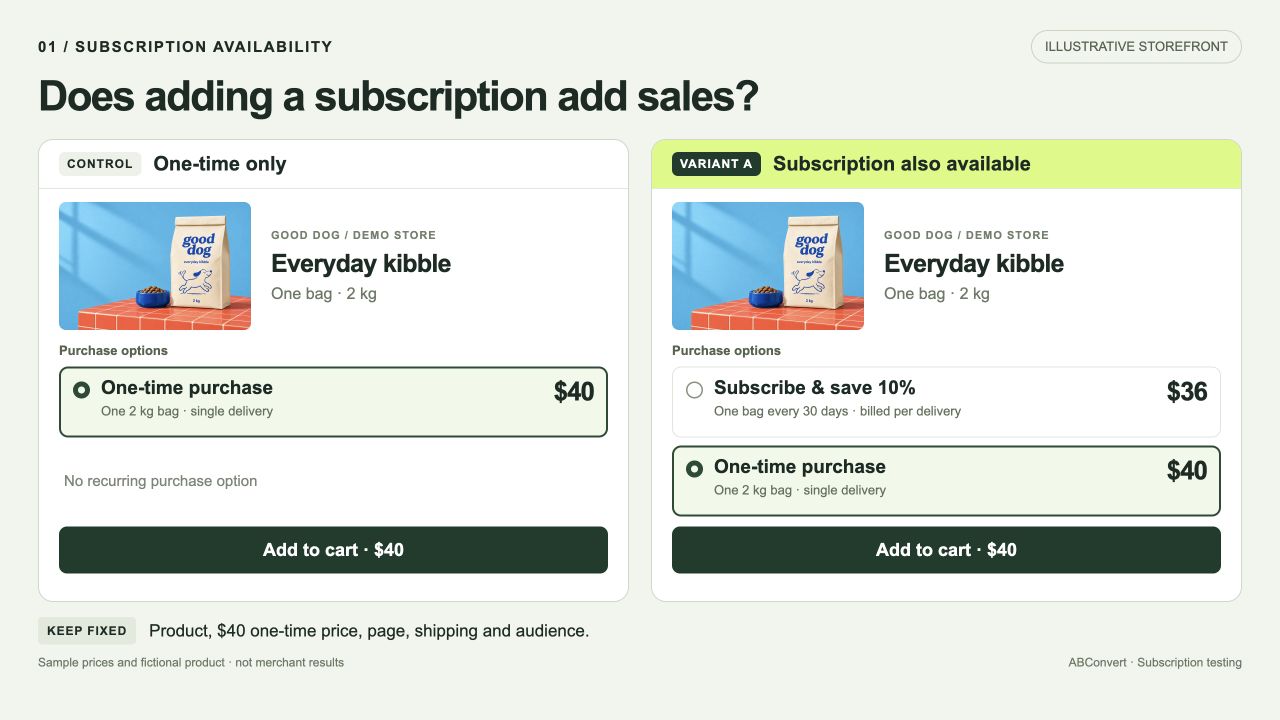
View the subscription availability comparison at full size
Keep the product, one-time price, page, shipping and audience consistent. The change you are testing is whether the subscription option is available.
A shopper who would have bought once at $40 might choose the $36 subscription instead. That could become a valuable repeat customer, but the signup alone does not establish its value.
Compare overall conversion and revenue per visitor across the variants. Those measures include shoppers who leave without buying, so they reveal a trade-off that subscription order counts can miss. Then follow paid renewals once the subscribers have reached their next billing dates.
For a worked example, give both variants the same amount of eligible traffic. Control produces 100 one-time orders at $40, for $4,000 in initial revenue. Variant A produces 75 one-time orders and 25 subscription orders at $36, for $3,900. Both have 100 orders. The subscription offer has changed the purchase mix, while the first-order revenue is $100 lower. Paid renewals and the cost of fulfilling them determine whether that trade-off is worthwhile. These are sample figures, not a merchant result.
03Give the discount a job to prove
If you already offer subscriptions, ask whether a larger saving earns its cost. Compare 10% off with 20% off while keeping the product, quantity and delivery schedule unchanged.
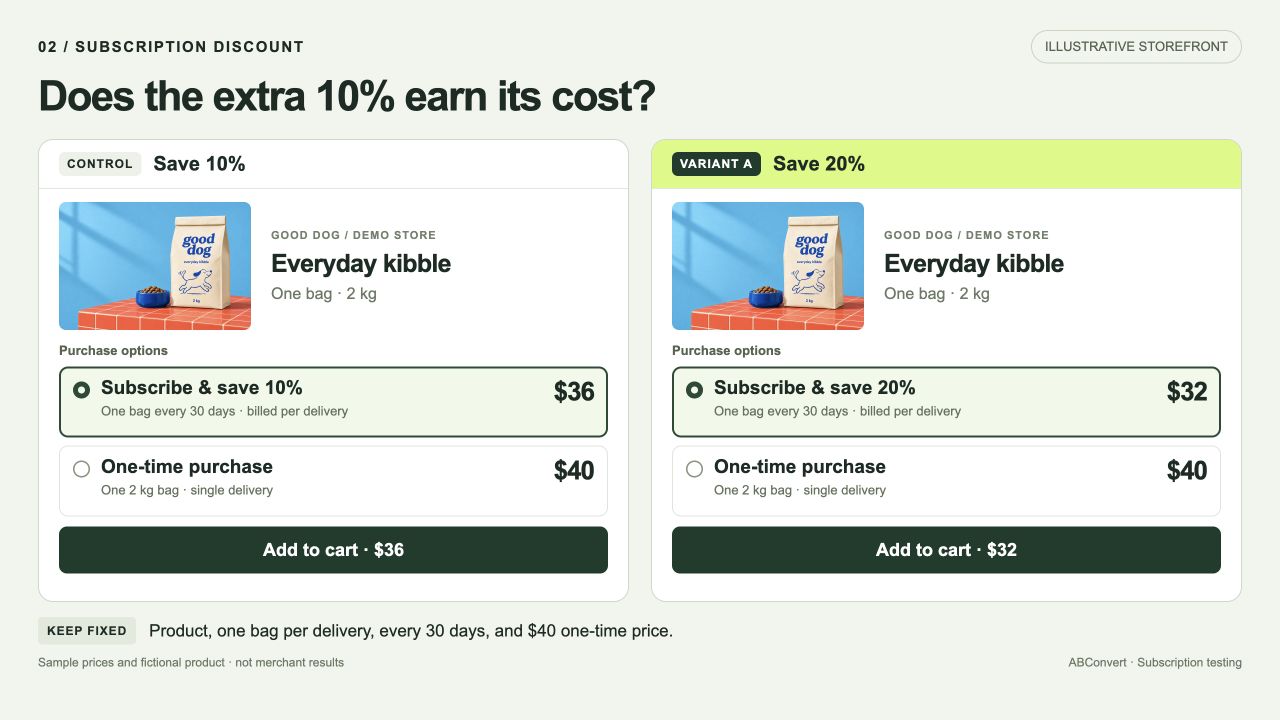
View the subscription discount comparison at full size
The deeper saving gives up another $4 on every paid delivery. It needs to bring in enough additional orders or lasting subscribers to support that lower price.
More signups at the lower price may be valuable. You also need to understand the revenue given up and whether those additional subscribers keep paying. A smaller discount that attracts almost as many customers can be worth considering.
The same discipline applies to a price test: choose the commercial question first, then read the result in the context of revenue and costs.
04Match the delivery schedule to the customer
Compare the same 2 kg bag at $36 every 30 days with $36 every 60 days. Keep the product, quantity and discount unchanged. Only the delivery interval changes.
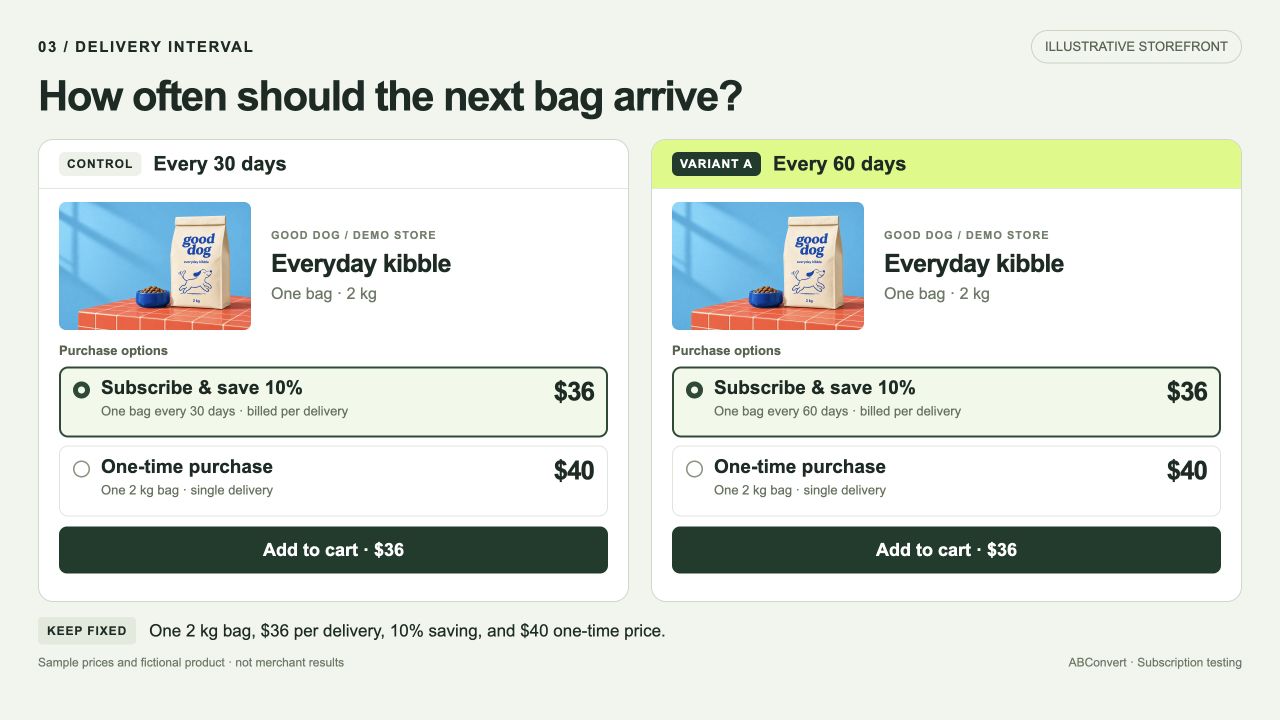
View the delivery interval comparison at full size
Give both variants a fair opportunity to renew. At day 30, an active 60-day subscription may not yet have produced another paid order. Compare outcomes over a common observation window, with the delivery intervals in mind.
If you change the quantity and schedule together, you can learn which complete offer works better. You cannot isolate which of those changes caused the difference.
05Follow the offer beyond the first order
For the first purchase, review overall conversion and revenue per visitor. For orders placed with a subscription plan, the subscription metrics show revenue per visitor, orders per visitor and the share of orders that include a subscription. Read these alongside the rest of your test results.
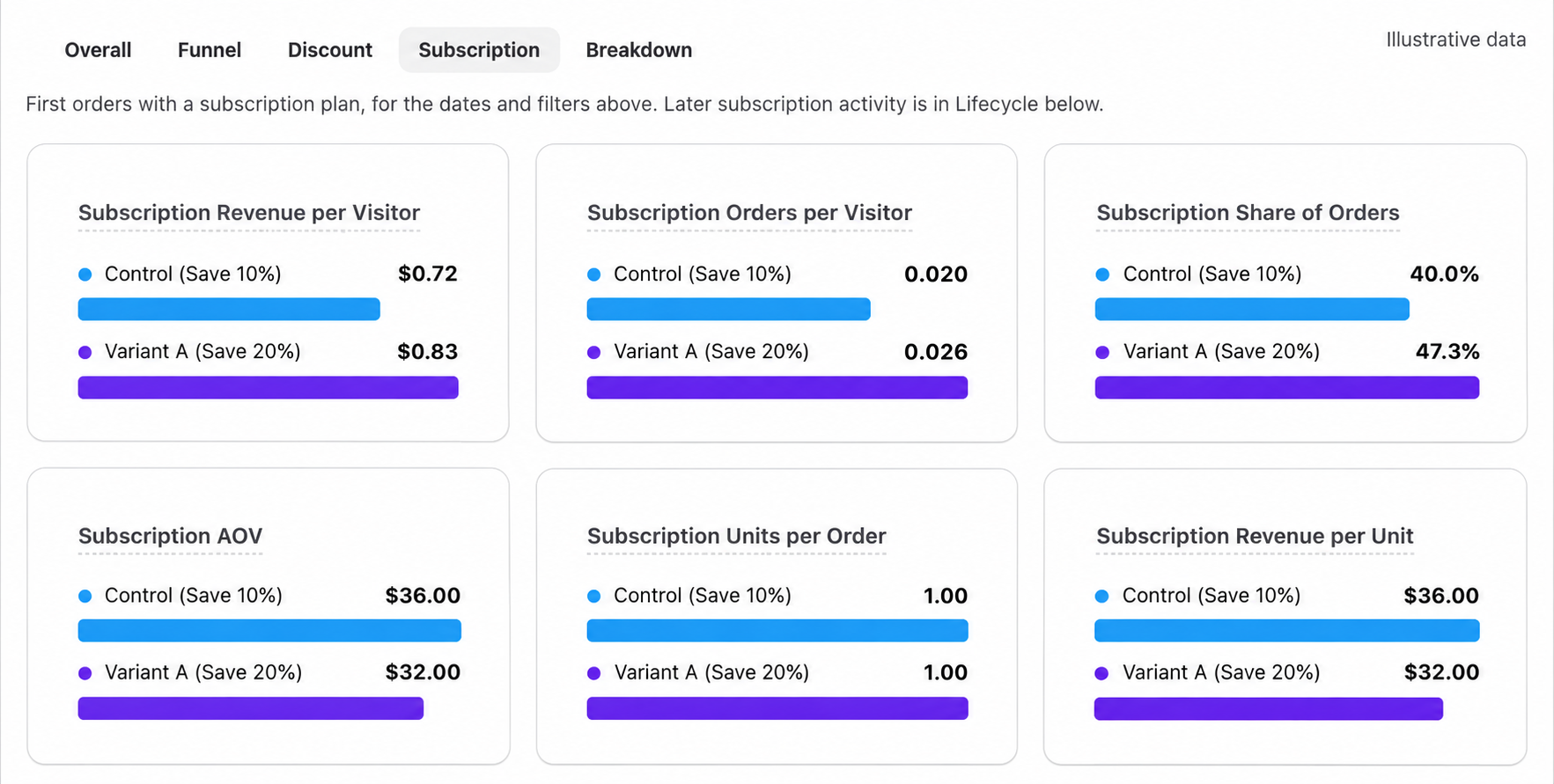
View the first-order dashboard demo at full size
In this illustrative discount test, 20% off brings in 260 subscription orders, compared with 200 at 10% off. The first-purchase result gives you an early signal. It does not yet tell you what happens after those customers sign up.
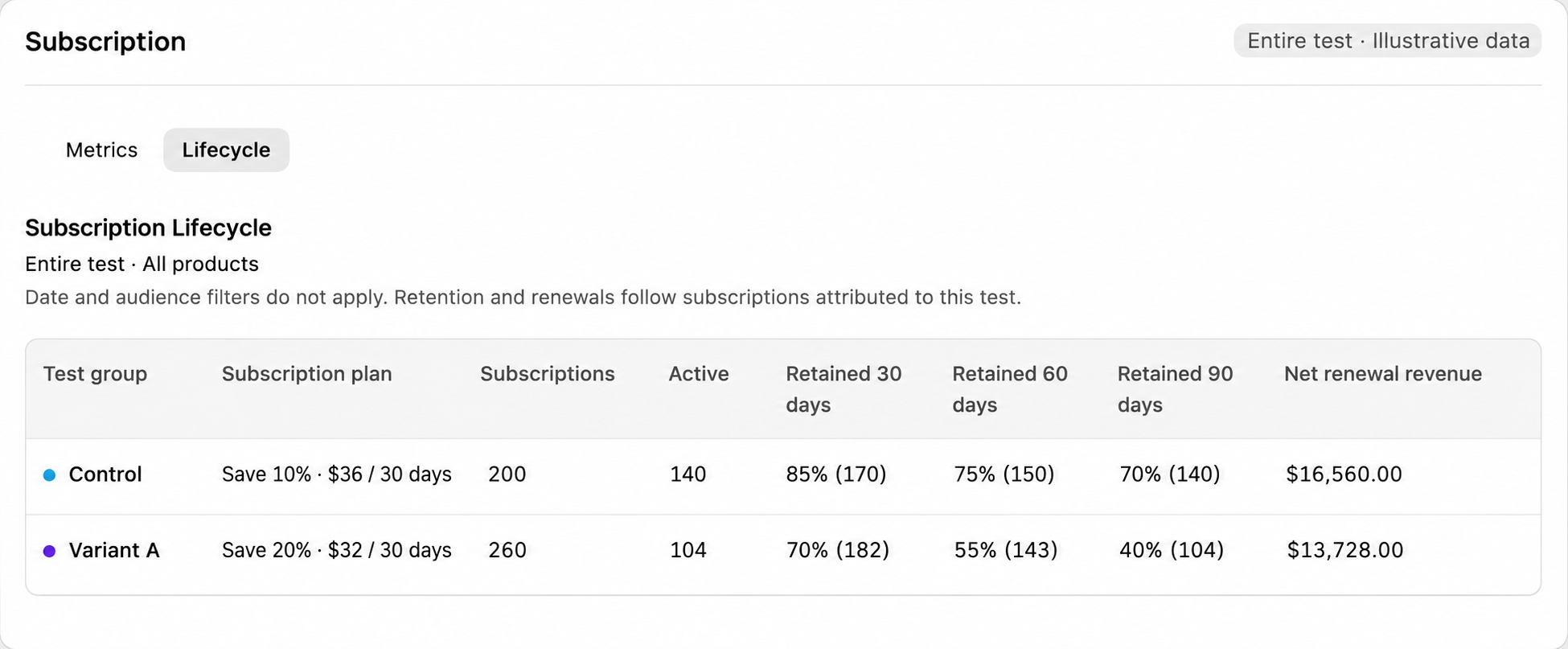
View the subscription lifecycle dashboard demo at full size
At day 90 in this example, the 10% offer has retained 140 subscribers, compared with 104 for the 20% offer. Net renewal revenue is $16,560 versus $13,728. The offer with more initial subscription orders has earned less from renewals. Review initial revenue and fulfillment costs as well before deciding which offer to keep.
Keep the reporting windows clear. First-order metrics follow the results page's date and audience filters. Lifecycle covers the entire test, so its figures are not the same filtered view of the same period.
06Keep the first test focused
- Choose one product and one clear question before adding more variants.
- Prepare the provider plans and confirm the available setup for your store.
- Preview the buying path on desktop and mobile before launch.
- Check overall purchases as well as subscription signups.
- Allow comparable time for renewals, then review the outcome alongside costs.
Subscription testing is in beta for Growth plans and above. Access and setup vary by provider. Confirm your provider connection and the available options with the team before building the test.
Prefer a walkthrough? Watch the subscription testing tutorial.
The setup tutorial covers the steps, and the feature reference explains provider-specific requirements.
The Good Dog product imagery and dashboard demos come from the ABConvert subscription testing booklet, which includes more illustrated offer ideas. The storefront comparisons here are explanatory mockups; they do not represent a live merchant store.
Choose a subscription offer to test
Start with one product and one question. Check beta access and provider requirements in the guide.