


How to Prepare Your Landing Page Before Scaling Paid Traffic
Learn how to prepare your landing page before scaling paid traffic, from matching the ad to the offer and proof to testing RPV on real traffic.
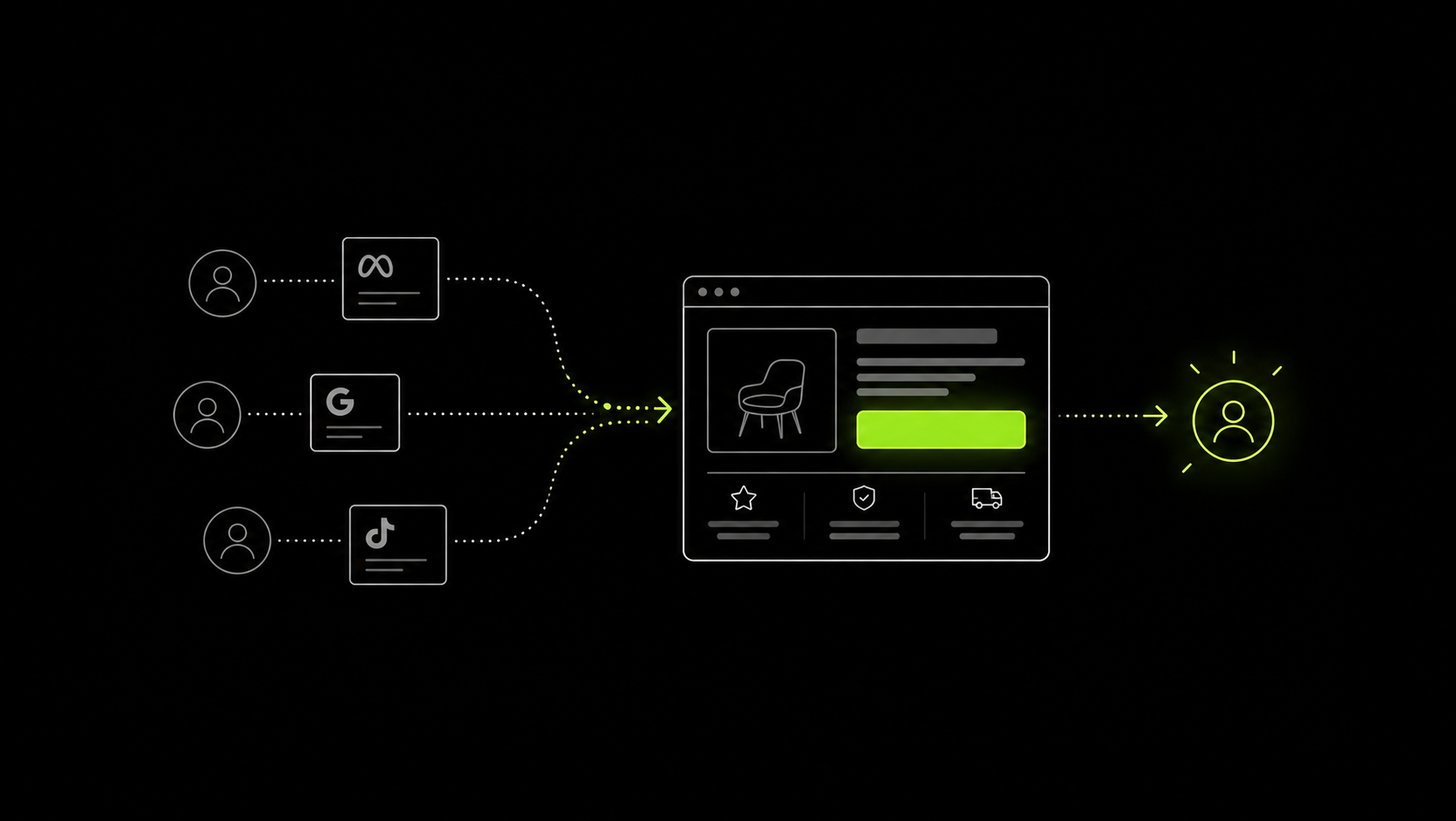
You need an optimized landing page before scaling paid traffic. But what does that look like?
It’s more than just about the visual experience. If visitors land on the wrong page, can't find the offer, or don't get the right information to decide, the traffic you paid for can drop off before they become customers.
We spoke to Jacob Elbaum, founder of Shivook, a conversion rate optimization agency that works with Shopify and DTC brands. He shared how his team prepares landing pages for high-volume paid traffic, what they fix before launch, and what they test once traffic starts flowing.
01Make sure the landing page reflects the ad
Start with where visitors land.
“The first question is not about the page at all. It is where the click lands.”
The landing page should carry the ad's promise through to the buy box: one product, one angle, and one reason to click.
If the ad sells a specific angle on a specific product, the landing page should continue that same argument through to the offer.
“Where the visitor lands decides more of the outcome than how the page underneath is built, and no amount of polish recovers a wrong destination.”
Avoid sending paid traffic to generic destinations
A homepage or broad collection page breaks that continuity because it gives the visitor another decision to make.
“A homepage or a broad collection page breaks that promise the moment it loads, because it hands the visitor a new decision instead of the answer they already clicked for.”
Shivook saw the same pattern in tests they ran for two brands.
For Free the Roots, an offer page replacing the collection page for Meta traffic increased RPV by 33%.
For Eiyan Lens, replacing the homepage with an offer page for Google Ads increased RPV by 52%.
Their team has a clear order of operations. Start with where the visitor lands, and then evaluate the offer, page type, and argument, before optimizing the layout, copy, and individual elements.
Fixing the destination comes before optimizing the page itself.
02Sell the offer through the landing page
A product page helps shoppers evaluate the product while an offer page builds the case for why they should buy it.
“A product page describes. An offer page argues.”
When building your offer page, lead with the core selling angle, bring the strongest proof forward, make the value of the offer clear, and reinforce trust close to the point of purchase.
“It states the reframe, stacks the proof, anchors a real price against a real reference price, and closes with a trust cluster under every buy button.”
Match the traffic to the page type
Cold paid traffic often needs more context than a standard product page provides. Instead of asking visitors to piece together the buying argument themselves, test a purpose-built offer page or a pre-sell layer before the product page.
“Cold paid traffic has not decided anything yet, and a spec sheet does not decide for them.”
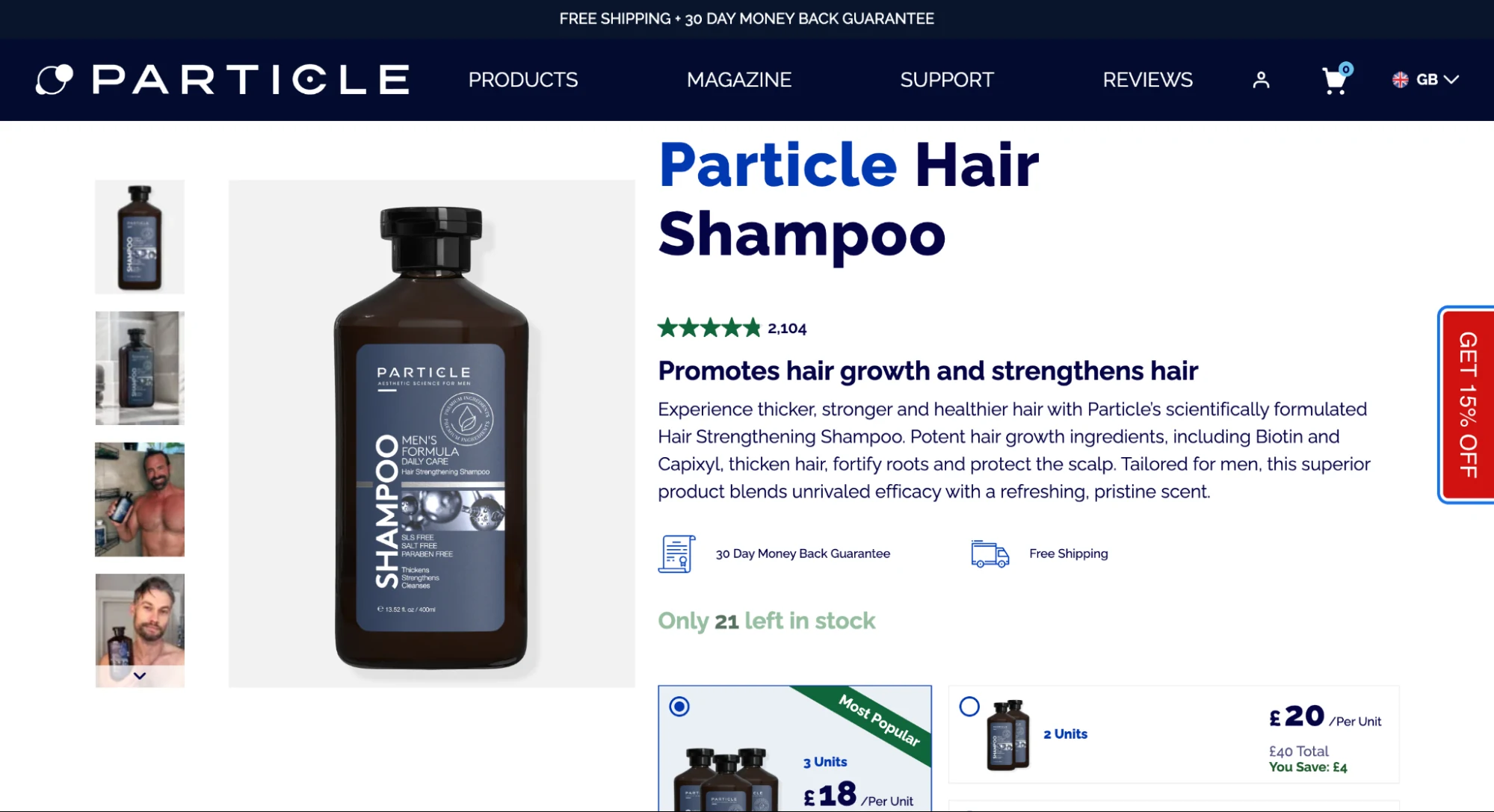
For example, Particle for Men was preparing to put more budget behind a flagship product when Shivook tested an offer page against the existing product page.
The new page used proof the brand already had and increased RPV by 21.4% at 99.5% confidence across 12,893 visitors. The page continued to drive results two years later.
“A page that survives two years of traffic is a very different asset from one that spikes in week one, and that durability is what you actually want before you scale spend.”
03The page needs credibility
Potential shoppers need evidence that they can trust the product before they can confidently decide to buy.
Start with the proof you actually have
At Shivook, Jacob’s team catalogs what the brand genuinely has: claims, credentials, results, reviews, clinical data, and other evidence. They then place that proof in the order that supports the buying decision.
If a brand has no clinical data, that section does not exist. The same applies to credentials or claims the brand can’t support.
“We never manufacture proof.”
Put strongest proof closer to the buying decision
Build the page around evidence that exists rather than fill gaps with weaker material.
Jacob's team places rating and review volume beside the product title, where visitors are already evaluating the product.
Deeper credibility, such as clinical results or an advisory board, goes further down the page, where continued reading signals stronger intent.
Don't pad a weak proof strategy with more content
If the proof is thin, adding more sections does not solve the problem. A shorter page with real proof is better than filling the page with material that doesn't strengthen the buying argument.
“A page with weak proof padded out with filler reads worse than a short page with real proof placed correctly.”
04Design a smooth mobile experience
Most paid traffic is mobile, so Jacob’s team treats mobile as a priority. A desktop screenshot isn't enough to approve the experience.
Go through the page on mobile from the landing page through purchase. Check the offer, page speed, buy box, proof placement, CTA, and the complete purchase path. If the page is slow or broken on mobile, hold traffic back until it’s fixed.
“A page that only holds together on a desktop screenshot is not ready.”
Before launch, check:
- Offer visibility
- Page speed
- Buy box
- Proof placement
- CTA
- Mobile layout
- Complete purchase path
05Set up measurement before you spend more
Before putting more money behind a landing page, you need to know whether it actually performs better than the page you're already running.
Measure the new page against the previous version
Run the new landing experience against the current page on the brand's own traffic.
Shivook uses RPV as the primary metric, with conversion rate and average order value as supporting metrics. Tracking also needs to be in place and working before the test starts.
“If we cannot read the result cleanly, we are not ready to spend.”
Don't rely on ad-platform revenue
The revenue reported by Meta or Google is not the same as the result of the landing-page test.
Ad platforms attribute revenue through their own systems, while the landing-page test compares the new experience directly with the current page on the brand's own traffic.
That's why Jacob's team reads the result from the A/B testing platform rather than using ad-platform revenue to judge the page.
Their tests compare the new page with the brand's existing page using live traffic and RPV.
06Fix problems and test decisions
Not every landing-page decision needs a test. Fix structural problems that are already clear, and then test the decisions where the right answer is still unknown.
Fix structural problems before launch
Fix structural problems before putting more traffic behind the page.
If paid traffic is going to the wrong page, the page has no clear offer, the mobile experience is broken, or tracking isn't working, fix it first.
“You do not run an A/B test to find out whether your landing page should make an offer. You fix it, then test the version of the question that is actually open.”
The same applies to a slow or broken buying experience. Fix the underlying problem first.
Test decisions where the answer is unclear
Once the structural problems are fixed, test the decisions where there are two credible options and the outcome affects revenue.
“These are real questions, and a controlled test is the only honest way to settle them.”
That could mean testing the angle, a listicle against a direct offer page, different price architecture, or different arguments for the same product.
Let traffic volume determine what you test
The amount of traffic you expect should influence the size of the questions you test.
High-volume traffic gives you enough resolution to test smaller changes.
With lower traffic, fix the biggest structural issues first and focus your testing on larger changes that can produce a meaningful result. An underpowered test can produce a number that looks actionable but isn't reliable enough to guide a decision.
Don't spend pre-launch time on micro-optimizations
Button colors, copy micro-edits, visual polish, and other individual elements should be improved after bigger decisions around the destination, offer, and page structure.
These changes are worth testing eventually, but they shouldn't delay the launch.
07Confirm the page performs before scaling traffic
Before giving a new landing experience more paid traffic, test it against the current page using the brand’s own live traffic.
“The signal that a page is ready to scale is not a feeling about the page. It is a result.”
A page is ready to scale when it has beaten the brand’s current page in a controlled test, on its own live traffic, measured in RPV, with a sample size that supports the result.
Don't switch high-volume traffic to an unproven page
If the current page is converting, don't switch all traffic to an unproven experience. Let the new page earn more traffic as it proves itself against the current page.
“One rule we do not break: we never cut a brand's converting traffic over to something unproven.”
Know what makes a result trustworthy
A large percentage lift isn't enough to call a test a winner. Look at the sample size and statistical significance behind the result.
“A large lift on a small sample is a direction, not a result.”
Shivook has seen 307% and 310% lifts from small samples. Those results can indicate that something is worth testing further, but a smaller lift backed by enough traffic gives you more to work with.
Traffic volume also affects what a test can resolve. With higher volume, smaller differences become easier to evaluate. With lower volume, Jacob recommends testing larger changes rather than relying on small differences.
Use RPV to evaluate the result
Jacob uses RPV as the primary measure, with conversion rate and AOV helping explain what drove the result.
A higher conversion rate doesn't necessarily mean the experience generated more revenue per visitor, particularly when the increase comes from a discount or a cheaper offer.
If conversion rate increases while RPV stays flat or falls, look at what's driving the conversion increase before scaling the page.
Higher spend makes structural mistakes more costly
The cost of a structural problem increases with traffic.
A wrong landing destination might be a small leak at 100 clicks a day, but the same problem becomes significantly more expensive at 5,000 clicks because every click is paying for the same mistake.
08Mistakes to avoid when setting up your landing page
Before scaling traffic, make sure you’re not making any of these mistakes:
- Sending paid traffic to a homepage or collection page: The visitor has to make a new decision instead of continuing from the ad.
- Redesigning the page without changing the argument: A new layout won't fix an offer that still isn't making the case for buying.
- Optimizing for CVR instead of RPV: Conversion rate can increase while revenue per visitor stays flat or falls.
- Relying on ad-platform revenue: Ad-platform attribution doesn't give you a clean read on what the landing page actually did.
- Calling a test too early: A large lift from a small sample is a direction, not a result.
- Padding weak proof with more content: More sections won't make weak or missing evidence stronger.
- Scaling an unproven experience: Don't cut converting traffic over to a new page until it has demonstrated that it can beat the current page at real volume.
09Case study: How landing on a listicle page as a pre-sell layer increased RPV
PIP Wellness had a product page that performed well with warm traffic. As the brand prepared to increase Meta spend, Shivook needed a stronger experience for cold visitors coming directly from the ads.
Using ABConvert, the team put a listicle-style page in front of the product page and matched it to the same angle as the ad, giving visitors the argument before they reached the offer.
The results were clear. The listicle-style page worked better. RPV increased from $0.40 to $0.66, a 64% lift. The test reached 94.19% confidence, just below the 95% bar.
The test showed how a pre-sell layer can give cold traffic the argument it needs before asking it to make the purchase decision.
10Final checklist: Is your landing page ready for high-volume ads?
Before increasing spend, run through these checks:
- Paid traffic lands on the right page type.
- Ad promise matches the landing experience.
- The page makes a clear offer.
- Genuine proof is present and correctly placed.
- Mobile experience is fully functional.
- Tracking is working correctly.
- RPV is the primary performance metric.
- The page has been tested against the current experience.
- The result has enough traffic to be trusted.
- Structural problems have been fixed before scaling.
Once these are in place, use controlled testing to identify which landing experience is worth scaling.
Ready to test your landing page?
Book a demo and start your next test with ABConvert.
Book a demo →


